

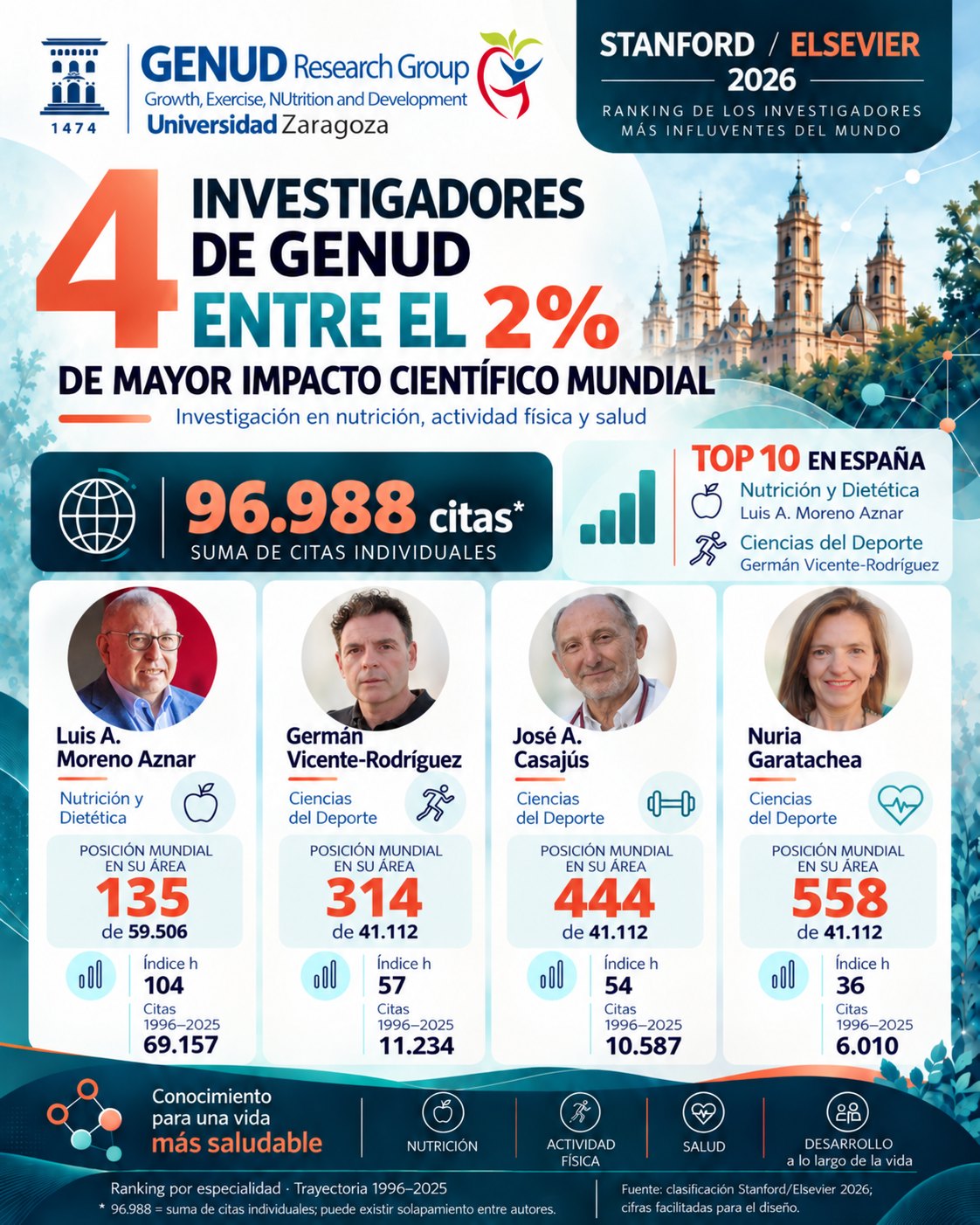
Zaragoza, 7 October 2026. Four researchers from the Growth, Exercise, Nutrition and Development (GENUD) group, linked to the University of Zaragoza, have been included in the 2026 edition of the prestigious Stanford/Elsevier ranking, an international classification that identifies the scientists with the greatest bibliometric impact in their respective fields.
The researchers recognised are Luis Alberto Moreno Aznar, Germán Vicente-Rodríguez, José Antonio Casajús Mallén and Nuria Garatachea Vallejo, whose scientific work ranges from nutrition and the prevention of childhood obesity to exercise physiology, body composition, healthy ageing and health promotion through physical activity.
The joint presence of four researchers is an important recognition of several decades of scientific work and of the group's ability to carry out competitive, interdisciplinary research with international reach.
What is the Stanford/Elsevier ranking and what does it assess?
The ranking, known internationally as the Stanford/Elsevier Top 2% Scientists, is based on the database of standardised bibliometric indicators developed by John P. A. Ioannidis and published by Elsevier using data from Scopus, one of the main international databases of scientific publications.
Its methodology does not consider only the number of publications of each researcher, but combines several indicators related to scientific impact, including:
- Number of citations received by their scientific publications.
- h-index, which relates productivity and impact of publications.
- hm-index, which adjusts the h-index for co-authorship.
- Authorship position in publications.
- Composite indicator of scientific impact (c-score).
The ranking classifies researchers into 20 major scientific fields and 174 subfields, allowing their indicators to be placed in the context of their respective specialities.
The 2026 edition uses Scopus data updated to the end of 2025 and distinguishes between cumulative impact over the whole research career and impact in the most recent year.
It is therefore a tool that recognises the visibility and reach of international scientific output, although its indicators should not be interpreted as a comprehensive assessment of the quality, innovation or social contribution of research.
Four internationally recognised scientific careers
The four GENUD researchers stand out in two major specialities: Nutrition & Dietetics and Sport Sciences.
Luis Alberto Moreno Aznar, Full Professor at the University of Zaragoza and an international reference in nutrition and childhood obesity, ranks 135th out of 59,506 researchers in Nutrition & Dietetics, placing him seventh in Spain in this speciality. His research has focused on epidemiology, the prevention of childhood obesity, eating habits and healthy lifestyles. He has led and participated in major international projects, including HELENA, IDEFICS and other European studies on child nutrition and health. His scientific output has received 69,157 citations and he has an h-index of 104.
Germán Vicente-Rodríguez, Full Professor of Physical Activity and Health at the University of Zaragoza, ranks 314th out of 41,112 researchers in Sport Sciences, placing him in the top 10 in Spain. His scientific activity has focused on exercise physiology, body composition, growth and healthy ageing. He leads the longitudinal EXERNET-Elder project, running since 2008, which has contributed to knowledge on physical fitness, frailty, sarcopenia and functional capacity in older adults, as well as to the design and evaluation of exercise interventions to improve their health and autonomy. He currently chairs the EXERNET research network on physical exercise and health. His publications have received 11,234 citations and he has an h-index of 57.
José Antonio Casajús Mallén, Full Professor at the University of Zaragoza and principal investigator of EXER-GENUD, ranks 444th worldwide in Sport Sciences. His career has contributed to the development of research on physical activity and health in different populations, the assessment of physical fitness and the use of exercise as a tool for prevention and treatment. He has played a leading role in creating and consolidating national research networks, especially EXERNET, and in promoting physical exercise as a public health tool. He has 10,587 citations and an h-index of 54.
Nuria Garatachea Vallejo, Full Professor at the University of Zaragoza and researcher at EXER-GENUD, ranks 558th worldwide in Sport Sciences. Her research has focused on physiological responses and adaptations to exercise, physical activity and health, ageing and longevity, and the application of new technologies to assess physical fitness. Her activity includes international scientific collaborations, supervision of doctoral theses and academic responsibilities related to the training of new researchers. She has 6,010 citations and an h-index of 36.
Together, the four researchers account for 96,988 individual scientific citations, a figure that reflects the broad international reach of their work. This number is the sum of their personal indicators and may therefore include citations to publications shared by several of them.
GENUD: more than four decades of research to improve health
The GENUD group (Growth, Exercise, Nutrition and Development) has a history dating back to 1984 and has become a leading multidisciplinary team in research on nutrition, physical exercise, growth, development and health across the life course.
Its activity brings together researchers from different disciplines and is organised into complementary lines of nutrition and physical exercise, developed by the NUTRI-GENUD and EXER-GENUD teams, among others.
Over these decades, its researchers have participated in and led numerous competitive national and international projects, establishing collaborations with universities, hospitals, research centres and scientific networks in different countries.
Its main contributions include studies on the prevention of childhood and adolescent obesity, body composition, lifestyles, physical fitness, ageing and the effects of physical exercise on health.
This track record is reflected in recent research on diet and obesity in childhood, the decline in physical fitness among European children and adolescents, and the effectiveness of exercise programmes to improve the autonomy of older adults.
GENUD's activity is also characterised by its commitment to knowledge transfer, with the aim of ensuring that research results help improve public health recommendations, prevention programmes and interventions aimed at different population groups.
A recognition for GENUD and the University of Zaragoza
The inclusion of four researchers in the 2026 Stanford/Elsevier ranking recognises their individual careers, but also the collective work carried out over decades by GENUD and by the many researchers, collaborators and young scientists who have taken part in its projects.
For the University of Zaragoza, this result strengthens its international visibility and highlights the relevance of the research carried out in its centres and scientific groups in areas of strategic importance for society, such as the prevention of chronic diseases, healthy eating, physical activity and ageing.
The recognition also shows the importance of maintaining consolidated teams, fostering international collaborations, attracting and training research talent and ensuring the continuity of scientific lines capable of generating knowledge in the long term.
Beyond the positions achieved in a ranking, GENUD's track record represents a sustained commitment to research that connects nutrition, exercise and health and seeks to turn scientific advances into real improvements for the population.
Four internationally recognised researchers, a collective track record of more than four decades and a shared goal: generating scientific knowledge to contribute to a healthier society.
Bibliometric sources: Ioannidis, J. P. A. (2026). August 2026 data-update for “Updated science-wide author databases of standardized citation indicators”. Elsevier Data Repository, version 9. DOI: 10.17632/btchxktzyw.9; and Scopus database.